

Simple Business Directory turns a WordPress website into a searchable business directory where administrators can curate listings, businesses can submit listings from the front end, and directory owners can monetize visibility through paid listings, subscriptions, featured placements, and claim-listing opportunities. Simple Business Directory Pro also supports Google Maps or OpenStreetMap, AI-assisted listing generation, front-end submissions, structured data, analytics, and payment integrations that can reduce manual work while creating new revenue opportunities.
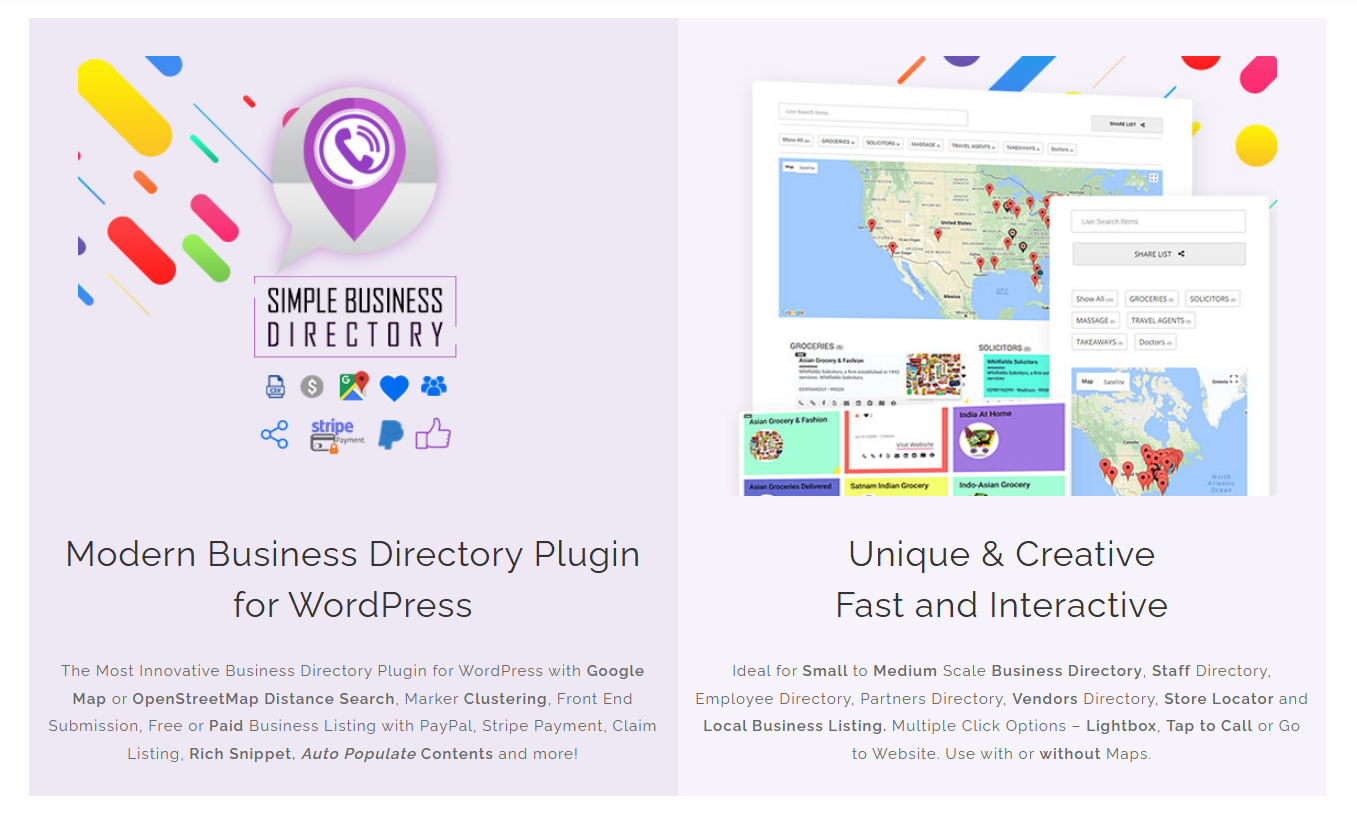
The real ROI of Simple Business Directory Pro is not limited to listing fees: Simple Business Directory can save administrator hours, create more indexable local content, improve discovery through structured listings and location search, and turn business-owner participation into a repeatable lead and revenue channel.
Why does Simple Business Directory Pro pay for itself faster than a manually managed directory?
A manually managed directory creates hidden operating costs long before a directory owner notices the problem.
Every new business requires data collection, formatting, image handling, location entry, category assignment, publishing, updating, and sometimes customer communication. Simple Business Directory Pro moves many of those repetitive tasks into a structured WordPress workflow.
Simple Business Directory Pro can automatically generate listing titles and descriptions from website links, generate thumbnails, and populate latitude and longitude from valid addresses. Simple Business Directory Pro also supports AI-assisted generation through Gemini, OpenAI, and OpenRouter for creating business information and bulk directory content.
Consider a directory with 300 listings.
If manual research, formatting, and publishing take an average of 8 minutes per listing, the initial workload reaches:
300 × 8 minutes = 2,400 minutes = 40 hours.
If Simple Business Directory reduces the average administrator workload to 3 minutes per listing through structured entry, automation, imports, and generated content, the workload becomes:
300 × 3 minutes = 900 minutes = 15 hours.
That represents approximately 25 hours saved during the initial build.
The exact savings depend on the quality of source data, automation settings, review requirements, and administrator workflow. The important point is that Simple Business Directory creates a repeatable workflow instead of forcing every listing through the same manual process.
How can Simple Business Directory turn saved administrator hours into measurable ROI?
Simple Business Directory creates measurable ROI when saved administrative time is assigned a realistic internal value.
For example, assume a directory manager values working time at $25 per hour. Saving 25 hours during a 300-listing build represents:
25 hours × $25 = $625 in recovered labor value.
If Simple Business Directory Pro costs less than the recovered labor value, the software has already generated positive operational ROI before considering listing revenue, SEO traffic, leads, or advertising.
Simple Business Directory becomes even more valuable when the directory continues growing after launch because the same workflow can be reused for hundreds or thousands of future listings.
Are manual business listing workflows quietly destroying your directory’s growth?
Manual listing management becomes expensive when directory growth depends entirely on an administrator.
Simple Business Directory provides structured listing management for business names, contact information, websites, addresses, descriptions, images, categories, and location data. Simple Business Directory can also display listings with maps, search, filtering, and multiple directory layouts.
A directory owner can organize businesses into separate lists instead of forcing every business into one enormous page. Simple Business Directory’s list-based architecture makes the same WordPress installation useful for local business directories, restaurant directories, staff directories, vendor directories, company directories, and other structured listing projects.
Simple Business Directory can reduce manual listing work through:
- Simple Business Directory automated title and description generation from website links.
- Simple Business Directory automated thumbnail generation using website information.
- Simple Business Directory automated latitude and longitude generation from valid business addresses.
- Simple Business Directory CSV import and export for bulk listing workflows.
- Simple Business Directory multiple lists for separating businesses by category, location, or niche.
- Simple Business Directory Google Maps and OpenStreetMap support for location-based directory experiences.
- Simple Business Directory search and filtering controls for helping visitors find relevant businesses faster.
The combination matters because directory growth creates a data-management problem before directory growth creates a traffic problem.
Simple Business Directory addresses the data-management problem first.
Can Simple Business Directory create stronger SEO without publishing hundreds of random blog posts?
Yes, but directory SEO should be treated as structured information architecture rather than a shortcut to rankings.
Simple Business Directory can organize businesses into focused lists and expose useful business information such as names, descriptions, locations, websites, phone numbers, categories, and images. Simple Business Directory Pro also supports Schema.org rich snippets with JSON-LD for multi-page mode, giving search engines machine-readable information about directory content.
A directory containing 500 genuinely useful businesses can create hundreds of distinct information resources.
That does not mean 500 pages automatically equal 500 ranking pages. Search visibility still depends on content quality, uniqueness, search intent, technical SEO, internal linking, authority, competition, and Google’s ability to determine whether individual pages provide useful information.
Simple Business Directory strengthens the foundation by turning business data into structured, organized website content.
Which Simple Business Directory SEO features can create additional search opportunities?
Simple Business Directory can support an SEO strategy built around business + location + category + intent combinations.
For example, a local directory could organize businesses around:
| Search structure | Example directory intent | Simple Business Directory role |
| Business category | Restaurants | Simple Business Directory category/list organization |
| Location | Restaurants in a specific area | Simple Business Directory location data |
| Service | Wedding photographers | Simple Business Directory business descriptions |
| Business + location | Dentists in a city | Simple Business Directory structured listings |
| Local discovery | Cafes near a neighborhood | Simple Business Directory map/location experience |
| Brand discovery | Local software companies | Simple Business Directory curated business lists |
Simple Business Directory does not guarantee rankings for any search query. Simple Business Directory provides the content structure and directory functionality needed to build pages around legitimate search demand.
Why can Simple Business Directory’s embed feature become an SEO growth loop?
Simple Business Directory allows directory owners to make curated business lists available for embedding on other websites. The official Simple Business Directory documentation states that embedded lists can include a backlink to the original directory, creating an additional sharing and link-acquisition mechanism.
The SEO value should be approached carefully.
Simple Business Directory cannot guarantee that every embedded directory produces a valuable backlink. Link relevance, placement, authority, crawlability, and the receiving site’s overall quality determine whether an external link contributes meaningful value.
The strategic advantage is distribution.
A useful directory list can move beyond the original website and become a resource that other organizations, communities, associations, bloggers, or local sites want to reference.
How much can Simple Business Directory save when a directory reaches 1,000 listings?
The savings become more obvious as the dataset grows.
Assume manual processing requires 7 minutes per listing.
1,000 × 7 minutes = 7,000 minutes = 116.7 hours.
If a structured Simple Business Directory workflow reduces average processing to 2.5 minutes:
1,000 × 2.5 minutes = 2,500 minutes = 41.7 hours.
Potential time recovered:
116.7 − 41.7 = 75 hours.
At an internal labor value of $25 per hour:
75 × $25 = $1,875.
Simple Business Directory’s actual savings will vary because some listings require deeper verification, manual editing, image replacement, category decisions, or compliance review.
The calculation demonstrates why directory software becomes more valuable as listing volume increases.
Business Listing Management
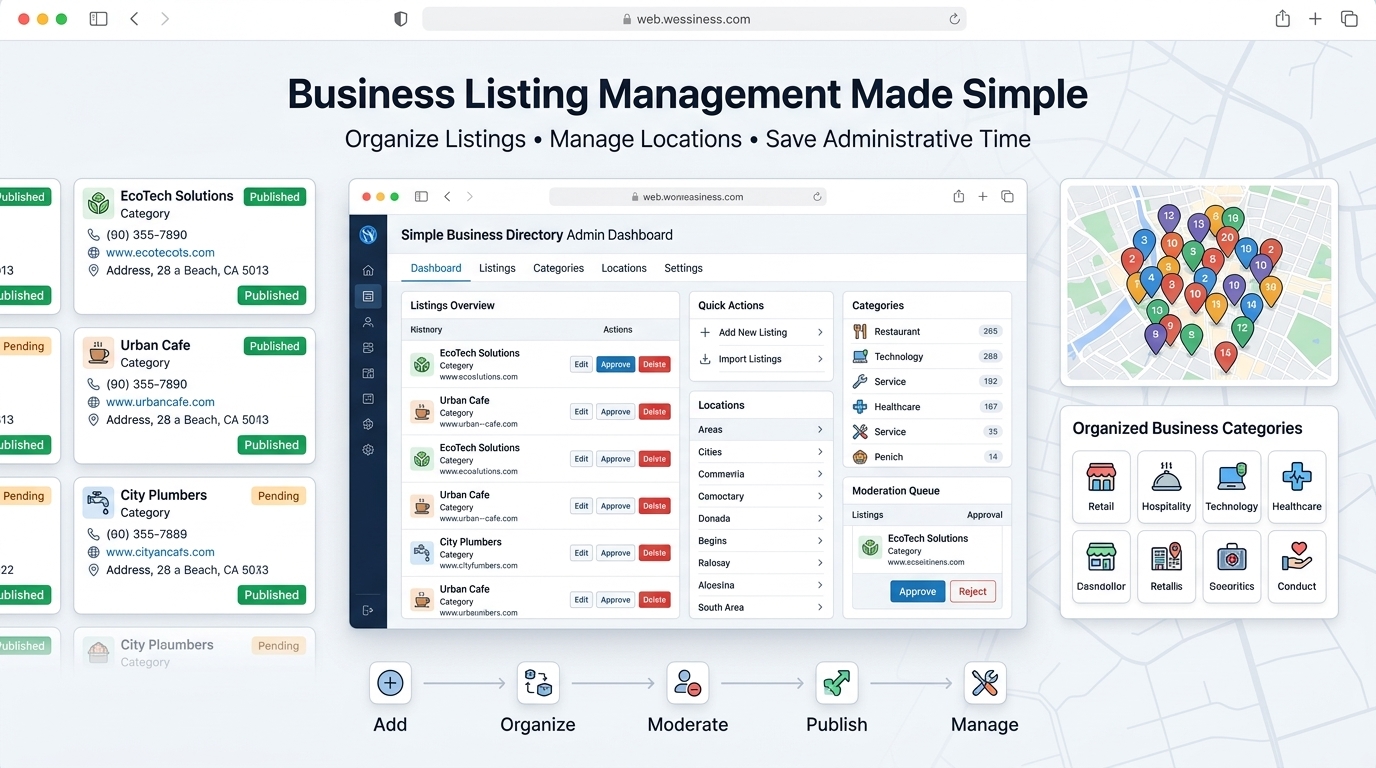
Why does Simple Business Directory make business listing management less painful?
Simple Business Directory provides a central WordPress-based workflow for creating, organizing, displaying, and maintaining business listings.
Simple Business Directory supports detailed listing information and multiple display approaches, allowing directory owners to build anything from a compact one-page local guide to a larger multi-page directory.
Simple Business Directory also supports Google Maps and OpenStreetMap, allowing location information to become part of the directory experience instead of remaining buried inside plain text fields.
Which Simple Business Directory features matter most for large listing databases?
Simple Business Directory listing organization separates businesses into manageable lists.
Simple Business Directory location support allows addresses to connect with latitude and longitude data.
Simple Business Directory map support gives visitors a visual discovery method.
Simple Business Directory responsive templates allow directory content to work across desktop and mobile layouts.
Simple Business Directory Gutenberg and page-builder compatibility makes directory placement easier inside existing WordPress websites.
Simple Business Directory CSV import/export provides a practical method for moving or backing up listing data.
The result is a directory workflow that can grow without requiring every listing to be designed manually.
Can Simple Business Directory help turn a spreadsheet into a searchable directory?
Simple Business Directory supports CSV import and export, making spreadsheet-based directory management much more practical.
A directory owner can prepare structured business data in a spreadsheet, map the relevant fields, import the dataset, review the resulting listings, and publish the directory through WordPress.
Simple Business Directory therefore creates a useful bridge between research workflows and public directory publishing.
For agencies, local publishers, and SEO teams, the workflow can be especially valuable because business research frequently begins outside WordPress.
Community Submissions & Moderation
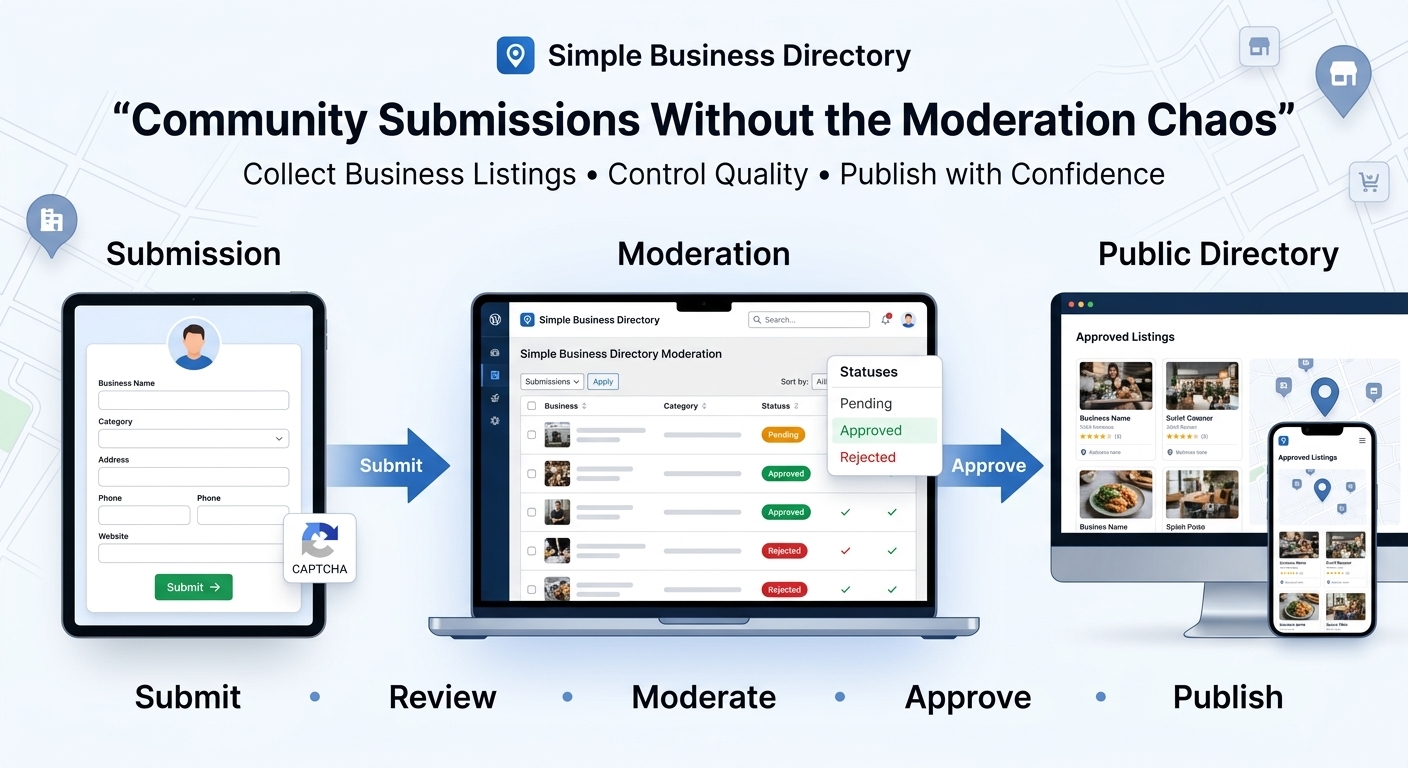
Why should Simple Business Directory let businesses submit listings instead of forcing administrators to enter everything?
A directory becomes easier to scale when businesses help populate the directory.
Simple Business Directory Pro supports front-end user registration, login, business listing submission, and administration of user-submitted businesses. Simple Business Directory also supports free or paid listing opportunities and configurable approval workflows.
That changes the operating model.
Instead of:
Administrator researches → Administrator enters → Administrator publishes
the workflow can become:
Business owner submits → Simple Business Directory receives → Administrator reviews → Business listing goes live
Simple Business Directory therefore shifts part of the data-entry workload from the directory owner to the business community.
How does Simple Business Directory moderation prevent community submissions from becoming a spam disaster?
Community submissions create leverage, but uncontrolled submissions create risk.
Simple Business Directory provides administrative controls for managing user-submitted businesses and allows administrators to approve submitted listings or configure automatic approval options. Simple Business Directory also supports front-end registration and CAPTCHA-based submission workflows.
A sensible moderation model should separate submission from publication.
Simple Business Directory recommended moderation workflow:
- Simple Business Directory receives the business submission.
- Simple Business Directory applies registration and CAPTCHA controls.
- Simple Business Directory keeps administrator approval enabled for higher-risk directories.
- Simple Business Directory allows the administrator to verify business name, website, address, and category.
- Simple Business Directory publishes approved listings.
- Simple Business Directory keeps the directory owner responsible for final editorial quality.
Simple Business Directory automation should reduce workload without eliminating editorial judgment.
Can Simple Business Directory turn business owners into a free content-production team?
Yes, within reasonable quality-control boundaries.
Simple Business Directory allows businesses and users to submit their own listings through the front end. Simple Business Directory can therefore turn directory participation into a distributed content workflow where businesses provide information about their own organizations.
The advantage is not simply saving data-entry time.
Business owners are often the people most capable of providing accurate operating information, contact details, descriptions, social profiles, and location data.
Simple Business Directory gives the directory owner a mechanism for collecting that information without giving submitters direct WordPress administration access.
How can Simple Business Directory create stronger engagement beyond basic listings?
Simple Business Directory supports user upvotes and configurable upvote icons, giving visitors a lightweight interaction mechanism. Simple Business Directory also allows registered users to create favorite lists and allows directory lists to be embedded on other websites.
These features can create additional behavioral signals inside the directory.
A visitor can discover a business, interact with a listing, save a favorite, or share a directory resource. Simple Business Directory therefore turns a static business database into a more interactive discovery system.
Monetization & Directory Growth
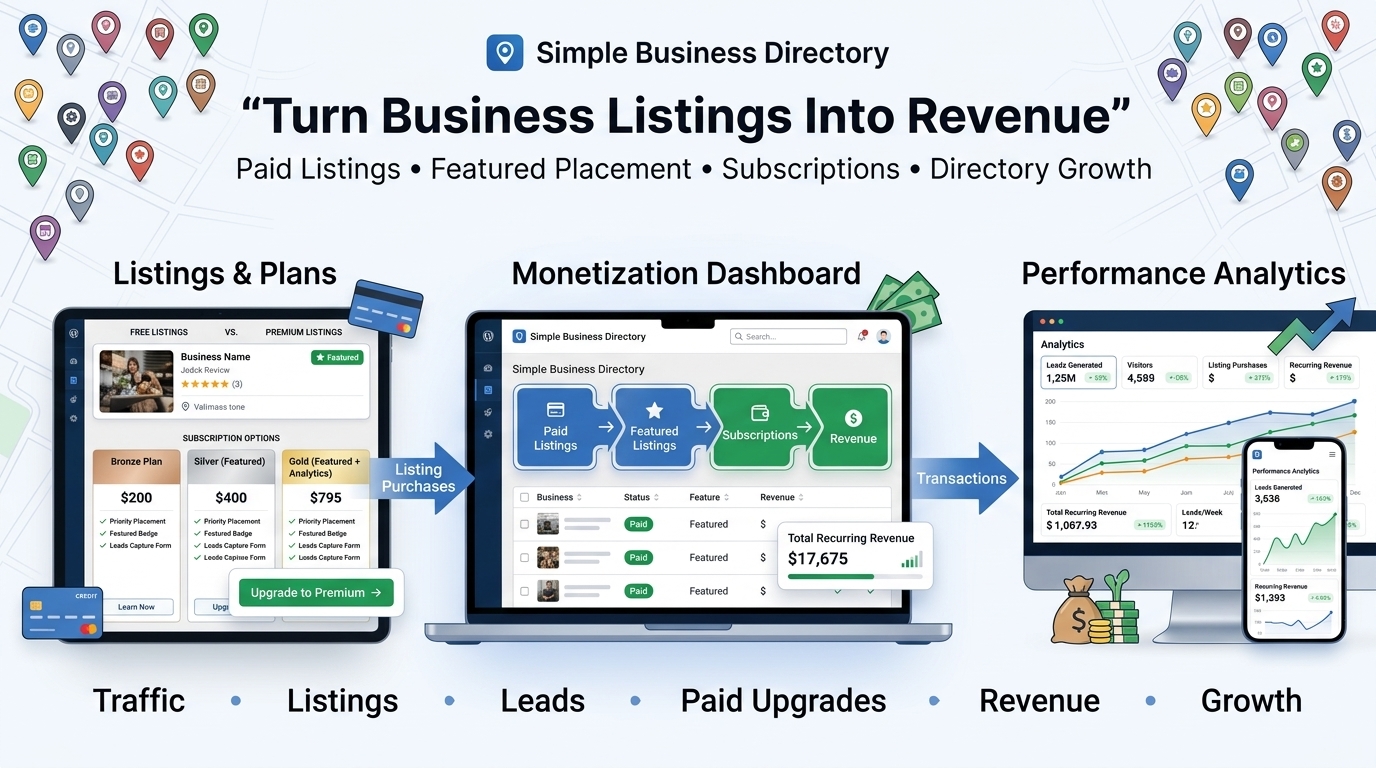
How can Simple Business Directory turn free traffic into direct revenue?
Simple Business Directory Pro supports paid business submissions through PayPal and Stripe. Simple Business Directory also supports subscription packages, paid or free listings, claim-listing fees, featured listings, listing visibility periods, and advertising/text blocks.
That gives directory owners multiple ways to monetize the same underlying business database.
| Monetization model | Simple Business Directory mechanism | Example |
| Paid submission | Simple Business Directory paid listing | $15/listing |
| Featured listing | Simple Business Directory featured placement | $25/month |
| Subscription | Simple Business Directory subscription package | $99/year |
| Claim listing | Simple Business Directory paid claim | $20/claim |
| Advertising | Simple Business Directory ad/text block | $100/month |
| Free + paid | Simple Business Directory mixed listing model | Free basic + paid premium |
The strongest model depends on the niche, traffic level, business value, and competitive landscape.
What does a realistic Simple Business Directory revenue model look like?
Consider a local directory with 500 active businesses.
Suppose Simple Business Directory generates:
- 30 paid listings per month × $15 = $450
- 10 featured upgrades × $25 = $250
- 5 annual subscription upgrades × $60 equivalent = $300
- 2 paid claim listings × $20 = $40
Potential monthly revenue:
$450 + $250 + $300 + $40 = $1,040
Annualized:
$1,040 × 12 = $12,480
That example is not a promise of revenue. Simple Business Directory provides the monetization mechanisms; traffic, niche demand, sales strategy, listing value, pricing, and audience quality determine actual revenue.
How can Simple Business Directory create more leads instead of simply more pageviews?
A directory earns stronger commercial value when visitors arrive with a specific business need.
A visitor searching for “wedding photographer in Dhaka,” for example, has a different commercial intent from a visitor reading a general photography article.
Simple Business Directory can organize businesses by category and location so visitors can move from discovery toward direct contact. Simple Business Directory listings can include phone numbers, websites, addresses, social links, and tap-to-call functionality, depending on configuration.
The directory therefore becomes a lead-discovery layer rather than merely an informational archive.
How should Simple Business Directory owners calculate whether the Pro license pays for itself?
Use a simple ROI equation:
Simple Business Directory ROI = Time Savings + Gross Directory Revenue + Incremental Lead Value − Software and Operating Costs
Consider a hypothetical monthly calculation:
| ROI component | Example monthly value |
| Administrator time recovered | $300 |
| Paid listings | $450 |
| Featured listings | $250 |
| Additional lead value | $200 |
| Total measurable benefit | $1,200 |
| Software/operating cost | $100 |
| Estimated net benefit | $1,100 |
The calculation should use actual business data rather than optimistic assumptions.
Simple Business Directory becomes financially compelling when the directory owner tracks hours saved, paid submissions, upgrades, leads, outbound clicks, and recurring customers instead of measuring success only through pageviews.
Can Simple Business Directory combine SEO growth with monetization?
Yes, and the combination is one of the strongest reasons to build a directory rather than a collection of isolated landing pages.
Simple Business Directory can create structured business content that attracts search traffic. Simple Business Directory can then provide commercial pathways through paid listings, featured placements, business claims, and direct business contact options.
The growth loop looks like this:
More useful listings → More useful directory pages → More search opportunities → More visitors → More business-owner interest → More submissions → More monetization → More resources for directory growth
Simple Business Directory does not create the loop automatically.
Directory owners still need niche research, quality control, SEO strategy, internal linking, promotion, analytics, and ongoing maintenance.
Which Simple Business Directory metrics should a serious directory owner track?
Simple Business Directory owners should track operational and commercial metrics together.
Simple Business Directory operational metrics:
- Simple Business Directory listing count: total published businesses.
- Simple Business Directory submission volume: new business submissions per month.
- Simple Business Directory approval rate: percentage of submissions approved.
- Simple Business Directory moderation time: average review time per submission.
- Simple Business Directory listing update rate: percentage of listings requiring corrections.
- Simple Business Directory outbound clicks: business website traffic generated from listings.
Simple Business Directory commercial metrics:
- Simple Business Directory paid submission revenue.
- Simple Business Directory featured listing revenue.
- Simple Business Directory subscription revenue.
- Simple Business Directory claim-listing revenue.
- Simple Business Directory revenue per 100 active listings.
- Simple Business Directory lead value per visitor.
Simple Business Directory can integrate with Google Analytics for outbound link click tracking, providing another useful measurement layer for directory performance.
Why does Simple Business Directory become more valuable as the directory gets bigger?
The economics of directory software improve when repetitive work increases.
A 30-business directory can be managed manually without much pain.
A 3,000-business directory is a completely different operational problem.
Simple Business Directory’s automation, CSV workflows, front-end submissions, structured listings, location functionality, and monetization options become increasingly useful as listing volume grows.
The critical concept is operational leverage.
Simple Business Directory does not merely help a directory owner publish the first 100 businesses. Simple Business Directory gives the directory owner reusable workflows for the next 100, 500, and potentially thousands of listings, subject to WordPress hosting capacity and database design.
How should developers evaluate Simple Business Directory before deploying a high-traffic directory?
Developers should evaluate Simple Business Directory using measurable technical criteria rather than feature-count marketing.
| Technical area | Simple Business Directory evaluation question |
| Database | How does Simple Business Directory behave with the expected listing volume? |
| Search | How quickly does Simple Business Directory return filtered results? |
| Maps | How many map markers are rendered per page? |
| AI | How are Simple Business Directory AI requests controlled and billed? |
| Privacy | What listing and user information is stored? |
| Security | What versions, patches, and advisories apply to the installed release? |
| Payments | How are Simple Business Directory payment callbacks handled? |
| Webhooks | What happens when an external endpoint responds slowly? |
| SEO | Are listing URLs, canonical URLs, schema, and indexing rules configured correctly? |
| Backups | Can Simple Business Directory listing data be exported and restored? |
Simple Business Directory should be load-tested against the actual directory configuration rather than judged from a small development installation.
What is the fastest practical path to positive ROI with Simple Business Directory?
Start with a narrow commercial niche instead of attempting to build a giant generic directory.
Simple Business Directory launch sequence:
- Simple Business Directory should target one high-intent niche.
- Simple Business Directory should organize listings around useful categories and locations.
- Simple Business Directory should import or curate an initial dataset.
- Simple Business Directory should enable front-end submissions.
- Simple Business Directory should keep moderation strict during the early growth stage.
- Simple Business Directory should create free and paid listing tiers.
- Simple Business Directory should offer featured visibility for businesses that need more exposure.
- Simple Business Directory should measure outbound clicks and conversion activity.
- Simple Business Directory should publish useful supporting SEO content around the directory niche.
- Simple Business Directory should reinvest early revenue into content, promotion, and directory quality.
The goal is not to create the largest directory.
The goal is to create a directory where each additional listing increases usefulness, search coverage, business participation, and monetization potential.
FAQ’s About Simple Business Directory
Simple Business Directory Pro turns a WordPress website into a searchable business directory where administrators can curate listings, businesses can submit listings from the front end, and directory owners can monetize visibility through paid listings, subscriptions, featured placements, and claim-listing opportunities.
Simple Business Directory Pro supports Google Maps or OpenStreetMap, AI-assisted listing generation, front-end submissions, structured data, analytics, and payment integrations that can reduce manual work while creating new revenue opportunities.
Simple Business Directory Pro can automatically generate listing titles and descriptions, generate thumbnails, populate latitude and longitude from valid addresses, and support AI-assisted generation, reducing the average administrator workload during the initial build.
Simple Business Directory creates measurable ROI when saved administrative time is assigned a realistic internal value, such as $25 per hour. The software can recover labor value, generating positive operational ROI before considering listing revenue, SEO traffic, leads, or advertising.
Simple Business Directory provides structured listing management for business names, contact information, websites, addresses, descriptions, images, categories, and location data, reducing manual listing work through automation and organized workflows.
Simple Business Directory can organize businesses into focused lists, expose useful business information, and support Schema.org rich snippets with JSON-LD, creating structured, organized website content that strengthens SEO foundation.
Simple Business Directory can support an SEO strategy built around business + location + category + intent combinations, allowing for structured information architecture that creates legitimate search demand.
Simple Business Directory allows curated business lists to be embedded on other websites, potentially generating valuable backlinks and creating a sharing and link-acquisition mechanism that can extend the directory's reach.
Does Simple Business Directory Pro really pay for itself?
Simple Business Directory Pro can pay for itself when the directory owner measures the three economic benefits that are easiest to overlook: time saved, commercial traffic created, and directory revenue generated.
Simple Business Directory reduces repetitive listing administration through automation, structured management, imports, front-end submissions, and AI-assisted content workflows. Simple Business Directory can strengthen the directory’s SEO foundation through structured business information, organized lists, location content, JSON-LD support, and embeddable resources.
Simple Business Directory also creates direct monetization opportunities through paid listings, subscriptions, featured placements, claim listings, PayPal, and Stripe.
The strongest ROI calculation is therefore not:
“How much does Simple Business Directory Pro cost?”
The better question is:
“How much administrative labor, search visibility, business participation, lead value, and listing revenue can Simple Business Directory create compared with running the same directory manually?”
For a serious directory project, that is the number worth measuring.


Leave a Reply